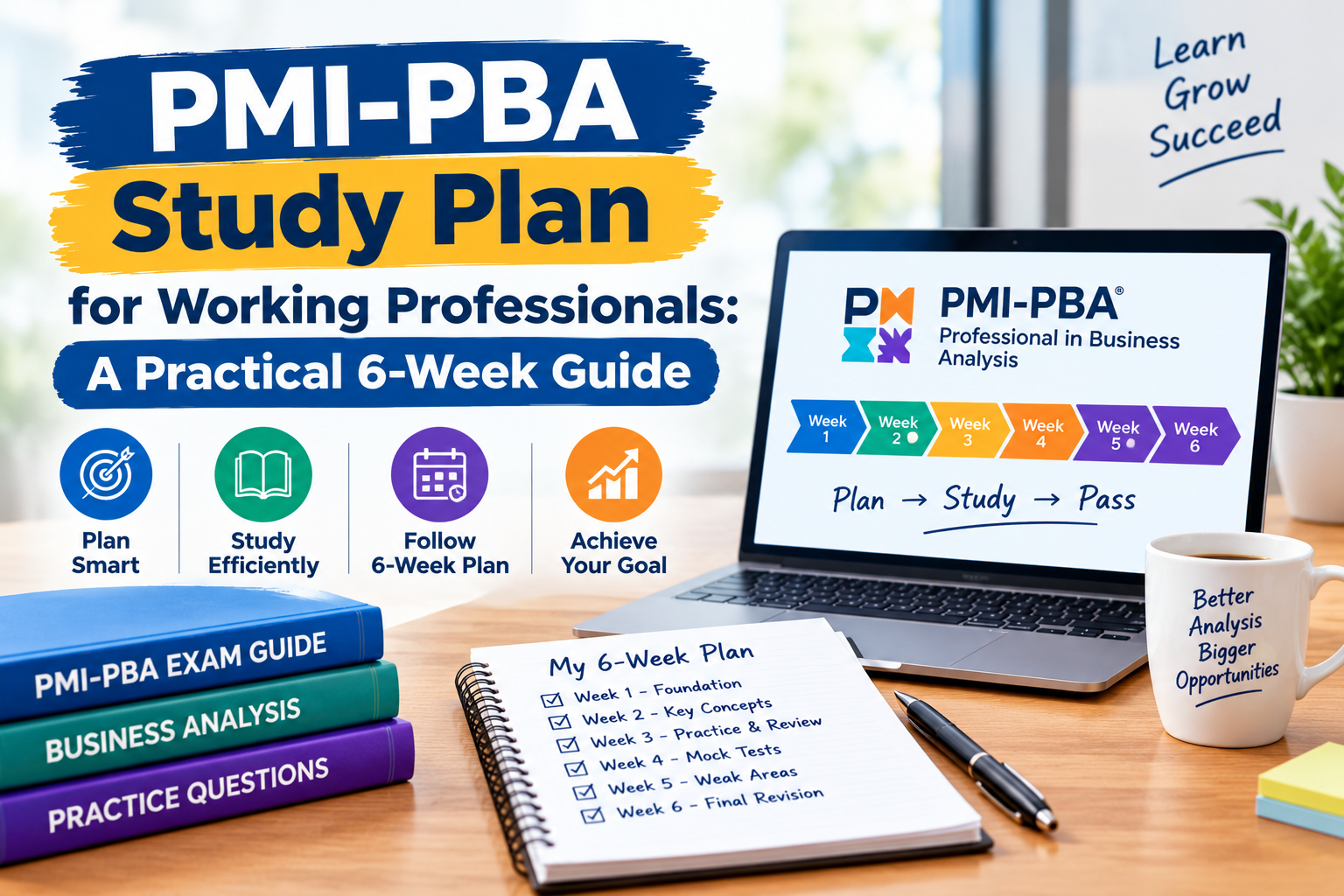
A practical PMI-PBA study plan for working professionals uses short, scheduled study blocks, a review of PMI’s current exam content outline, and regular practice with scenario-based questions. Start by checking your readiness and identifying knowledge gaps. Then spend six weeks covering the five exam domains, reviewing mistakes, and taking timed mock exams. Set aside about seven to nine hours each week, adjust the schedule around your work commitments, and use your business analysis experience to connect concepts to realistic project situations.
If you’re preparing while balancing a full-time role, family commitments, or project deadlines, build your study plan around the time you can reliably protect each week. Use this PMI-PBA study plan for working professionals as a framework, then adjust the weekly targets to your experience and exam date.
Start with the PMI-PBA exam content outline
Before choosing a PMI-PBA study guide or exam preparation course, review PMI’s current Exam Content Outline (ECO). It describes the topics assessed and assigns a percentage to each domain. PMI lists five exam domains: Needs Assessment (18%), Planning (22%), Analysis (35%), Traceability and Monitoring (15%), and Evaluation (10%).
Analysis carries the largest weighting, so plan to spend more time on it. However, a strong study plan covers all five domains. The percentages help you allocate study time; they do not guarantee how many questions you will see in a specific session.
| PMI-PBA exam domain | Exam weighting | Suggested study emphasis |
|---|---|---|
| Needs Assessment | 18% | Business problems, opportunities, stakeholders, and value |
| Planning | 22% | Business analysis planning, communication, and governance |
| Analysis | 35% | Elicitation, requirements analysis, models, and solution options |
| Traceability and Monitoring | 15% | Requirements relationships, status, and change control |
| Evaluation | 10% | Solution performance, limitations, and value delivery |
The exam has 200 questions and a four-hour time limit. That gives you an average of about 72 seconds per question, though some questions may take longer than others. Use timed practice to improve your pacing and build the stamina needed to stay focused.
Download the latest ECO from PMI before beginning your PMI-PBA exam prep. Use its tasks and topics as a checklist, and make sure your PMI-PBA study guide or course aligns with the current outline.
Build a six-week PMI-PBA exam study plan
The schedule below is a suggested approach, not a schedule prescribed by PMI. It assumes you can study about seven to nine hours per week. If that is too much alongside your work and personal commitments, extend the plan to eight or ten weeks. A steady routine gives you more time to understand the material and revisit difficult concepts.
Week 1: Check your starting point and organize
Read the ECO and mark topics that are familiar, uncertain, or new. Take a short diagnostic quiz or answer a small set of PMI-PBA practice questions. Treat the result as a baseline, not a judgment of whether you are ready to pass.
Create a simple tracker with the five domains, study hours, quiz results, and questions to review. Choose study blocks you can maintain, such as three 45-minute weekday sessions and one two-hour weekend session. Put them on your calendar and decide what each session will cover.
Week 2: Study Needs Assessment and Planning
Review the tasks and concepts in these two domains. Focus on how a business analyst helps clarify a problem or opportunity, understand stakeholder needs, and plan business analysis work. Connect each topic to a project you know. Ask yourself what information was gathered, who needed to be involved, and how the team defined a successful outcome.
Finish the week with a set of practice questions. For every missed answer, write down why the correct option fits the situation and why your choice did not. Reviewing your reasoning helps more than recording a score alone.
Weeks 3 and 4: Focus on Analysis
Give Analysis the largest share of your study time because it represents 35% of the exam. Work through the relevant topics in the current ECO, such as elicitation and collaboration, requirements analysis, models, prioritization, and validation.
Use short learning cycles: study one concept, explain it in your own words, and answer a few related questions. When you read a scenario, identify the business need, the relevant stakeholders, and the information available before looking at the answer choices. This helps you reason through unfamiliar situations instead of relying only on memorized terms.
Week 5: Cover Traceability and Monitoring, then Evaluation
Review how requirements are traced, monitored, and managed as they change. Then study Evaluation, including how to assess solution performance and whether expected value is being achieved. Use examples from your work to make these concepts concrete, but check your understanding against the ECO and your study materials. Workplace practices can differ, and the exam tests the outline’s concepts.
At the end of the week, take a timed PMI-PBA mock exam for certification preparation. Review every incorrect answer and any correct answer you guessed. Sort mistakes into categories such as a content gap, a misread question, or a rushed decision. Use those patterns to plan your final week.
Week 6: Review, test, and taper
Revisit your two weakest domains and complete targeted practice. Take another timed mock exam under exam-like conditions, including a quiet environment and a strict time limit. Use your results to identify the concepts that still need attention.
Avoid trying to learn every remaining detail the night before. Use the final day for a light review, exam logistics, and rest. A clear mind can help you read scenarios carefully and manage your time.
How to study for the PMI-PBA exam around a full-time job
Consistency matters more than occasional marathon sessions. Choose study blocks that fit your actual schedule, and give each one a specific goal. “Study Analysis” is vague; “review prioritization, then answer 15 related questions” gives you a clear task and stopping point.
These methods can help you keep your PMI-PBA exam study plan manageable:
Use 30- to 45-minute weekday sessions for flashcards, a domain summary, or a few questions.
Reserve a longer weekend session for reading, scenario analysis, or a mock exam.
Keep a mistake log with the domain, the reason for the error, and the clue you overlooked.
Use active recall by explaining a concept from memory before checking your notes.
Build in rest and make-up time so one missed session does not derail your schedule.
The PMI-PBA certification is designed for professionals with business analysis experience. PMI’s eligibility pathways vary by education level, but include relevant business analysis experience and 35 contact hours of business analysis education. Check PMI’s current eligibility requirements and confirm that your experience and education meet the pathway that applies to you before scheduling the exam.
Choose study resources that support application
The best study resources for the PMI-PBA exam should align with the current ECO and help you apply concepts to realistic situations. Use the outline as your checklist, a PMI-PBA study guide or business analysis reference for structured learning, and practice tests to check your understanding.
A useful resource mix can include:
The latest PMI-PBA Exam Content Outline.
A structured study guide or relevant business analysis reference.
Practice questions with answer explanations.
A mock exam you can complete under timed conditions.
Examples from your own projects to connect concepts with experience.
A PMI-PBA exam preparation course may offer a schedule, instructor guidance, and opportunities to ask questions. Before enrolling, compare its syllabus with the current exam domains and check whether it includes practice tests. A PMI-PBA exam preparation course with practice tests can help you combine content review and question practice, but it should complement your own review rather than replace it.
Choose practice material that explains why an answer is appropriate. Avoid unauthorized exam dumps or claims of guaranteed questions. Memorizing answer keys will not build the judgment needed to work through unfamiliar scenarios.
Make practice questions and mock exams count
PMI-PBA practice questions with answers and explanations can help you find knowledge gaps and improve your reasoning. Don’t repeat quizzes just to raise your score by remembering answers. After each set, ask whether you misunderstood the business need, overlooked a stakeholder, confused analysis with evaluation, or chose an action before enough information was available.
Use a mock exam early only if you want a baseline. Later, complete at least one timed simulation to practise pacing. With four hours for 200 questions, your average working time is about 72 seconds per question. If an item is taking too long, make your best decision and move on; return to it later if your exam interface allows you to review questions.
When reviewing a mock exam, look for patterns instead of focusing only on the overall score. If most errors come from one domain, devote more time to it. If you understand the content but run out of time, practise making a first-pass decision and returning to difficult items. Reviewing both incorrect answers and guesses can show where your understanding is uncertain.
Tips to pass the PMI-PBA certification exam
Your preparation should help you apply business analysis concepts across the full exam outline. Keep these points in mind:
Study all five domains, with extra time for Analysis.
Read each scenario carefully and identify the business need before choosing an action.
Practise with explanations so you understand the reasoning behind each answer.
Review mistakes and guesses instead of focusing only on quiz scores.
Use timed practice to improve pacing without rushing every question.
Check your eligibility, identification, and exam arrangements in advance.
Use this plan as a starting point, then adjust it to your diagnostic results and weekly availability. Review the PMI-PBA certification information as you plan your next steps. Schedule your exam when you have covered all five domains, reviewed your weaker areas, and completed timed practice. For questions about available support, contact the team.
About the author
NYTCC is at the forefront of security and technology education, providing premier IT security training and information security consulting. Our mission is to empower individuals by helping them achieve their educational and professional objectives. NYTCC provides high-quality training programs to boost our clients' success, enhance their professional reputation, and improve their marketability. Become an expert in IT security and unlock new opportunities with NYTCC.
Comments
Join the discussionNo comments yet. Be the first to comment.